Practice management software tends to assume one pet has exactly one owner, forever. Real life isn't like that. A dog is owned by a couple, and either one might bring it in. A cat is surrendered and adopted by a new family. A breeder's litter goes home to eight different households. An elderly client can no longer care for their pet, and a relative takes over. Every one of these is routine in a clinic — and every one of them is awkward in software that only models a single, fixed owner.
The awkwardness isn't cosmetic. How your system handles an ownership change determines whether the pet's medical history survives intact, whether the right person gets the reminders and invoices, and how much manual data entry your front desk has to do. Get it wrong and you either lose continuity of care or you create work that nobody has time for.
The duplicate-record trap
When a pet changes owners, the most common workaround in rigid systems is to create a brand-new patient record under the new owner. It's fast in the moment, and it's the wrong move. The new record starts empty: no vaccination history, no prior diagnoses, no allergy alerts, no weight trend. The vaccine the previous owner paid for last spring is now invisible, so the pet looks overdue when it isn't. A known drug sensitivity doesn't follow, which is a genuine clinical risk, not just a tidiness problem.
The other workaround — leaving the pet under the old owner and just editing the name and contact details — loses the previous owner entirely. That's fine until you need to know who the pet belonged to during a course of treatment, or the old owner calls about a balance, or there's a question about consent for a procedure done before the handover. The history of who was responsible when matters, and overwriting it erases it.
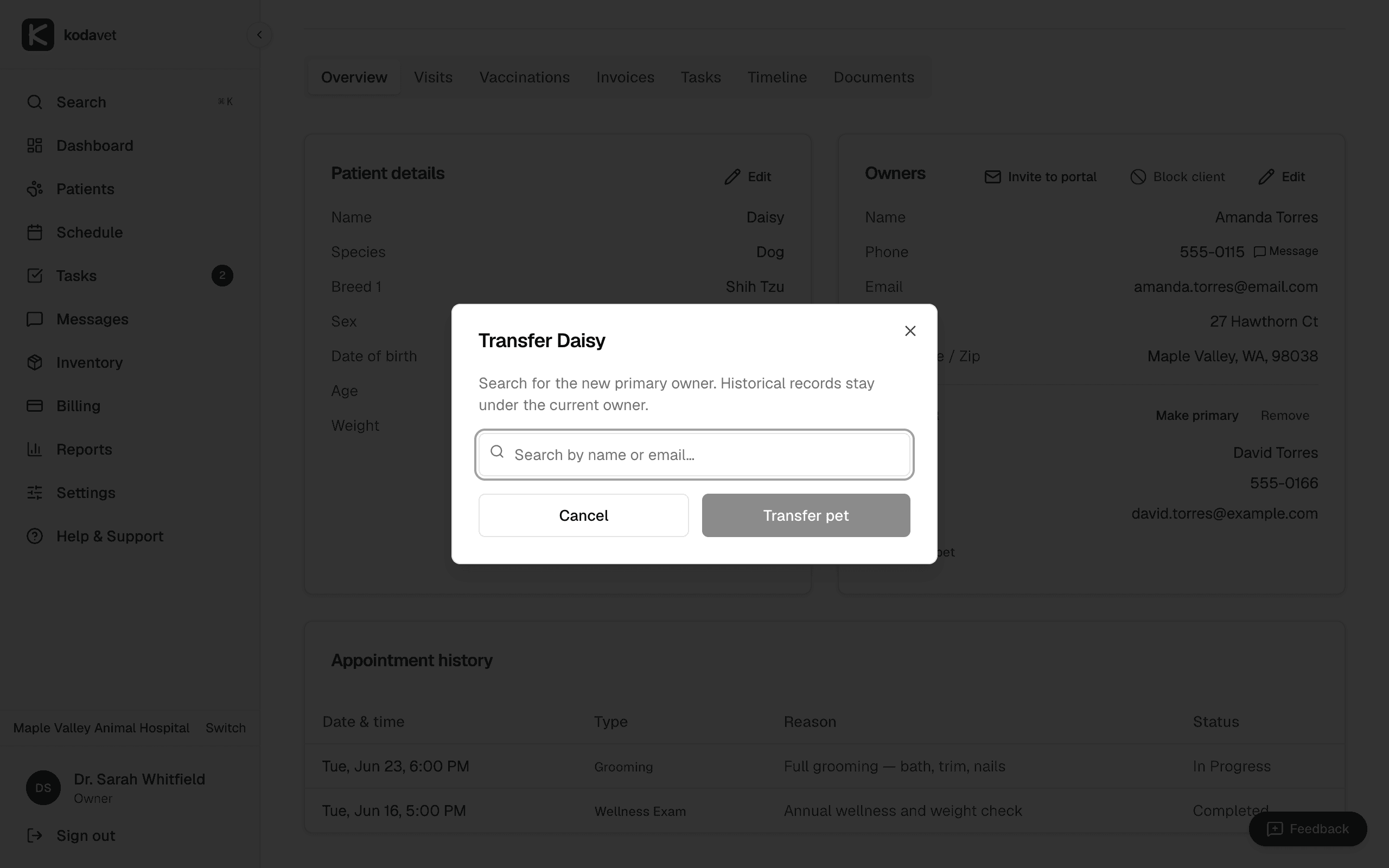
What you actually want is to move the pet to the new owner while keeping every appointment, encounter, and invoice attached to the patient — and a record that the transfer happened. The pet's chart is continuous; only the responsible party changed.
Co-owned pets are the rule, not the exception
Plenty of pets have two people behind them: married couples, partners, roommates, a parent and an adult child. Either person may book the appointment, sign for treatment, or pay the bill. If your system only allows one name on the record, the other person becomes a problem to solve at the front desk every time they call — "I don't see you on this account" is a frustrating thing to hear when you've been bringing the dog in for years.
Supporting a second owner on the record fixes this quietly. Both names, both phone numbers, both emails live on the patient. Reception can verify either caller without hunting. And when circumstances change — a separation, or one person taking over primary responsibility — you promote the co-owner to primary with a click rather than rebuilding the record around them.
When a pet is rehomed or adopted
Rehoming and adoption are the cleanest test of whether your software respects history. A shelter or rescue partner relocates an animal; a private owner can no longer keep their pet and a friend takes it on. In all of these the medical story should be preserved in full and simply re-pointed to the new household.
The right workflow is a single action: relocate the pet to a new primary owner, and the appointments, encounters, and invoices come along automatically. The new owner sees a complete chart from day one — which is exactly what good continuity of care requires, and exactly what a new owner is anxious about when they take on an animal whose past they don't fully know. For clinics that work closely with shelters and rescues, this turns what used to be a re-typing chore into a five-second step.
The records request that comes next
Ownership changes have a predictable sequel: someone needs the records sent somewhere. A new owner wants a copy. A referral practice needs the history before a specialist visit. The previous owner asks for documentation. Done by hand, this means assembling vaccination dates, recent visits, current medications, and any alerts into an email — a tedious few minutes that tends to get deprioritized when the clinic is busy.
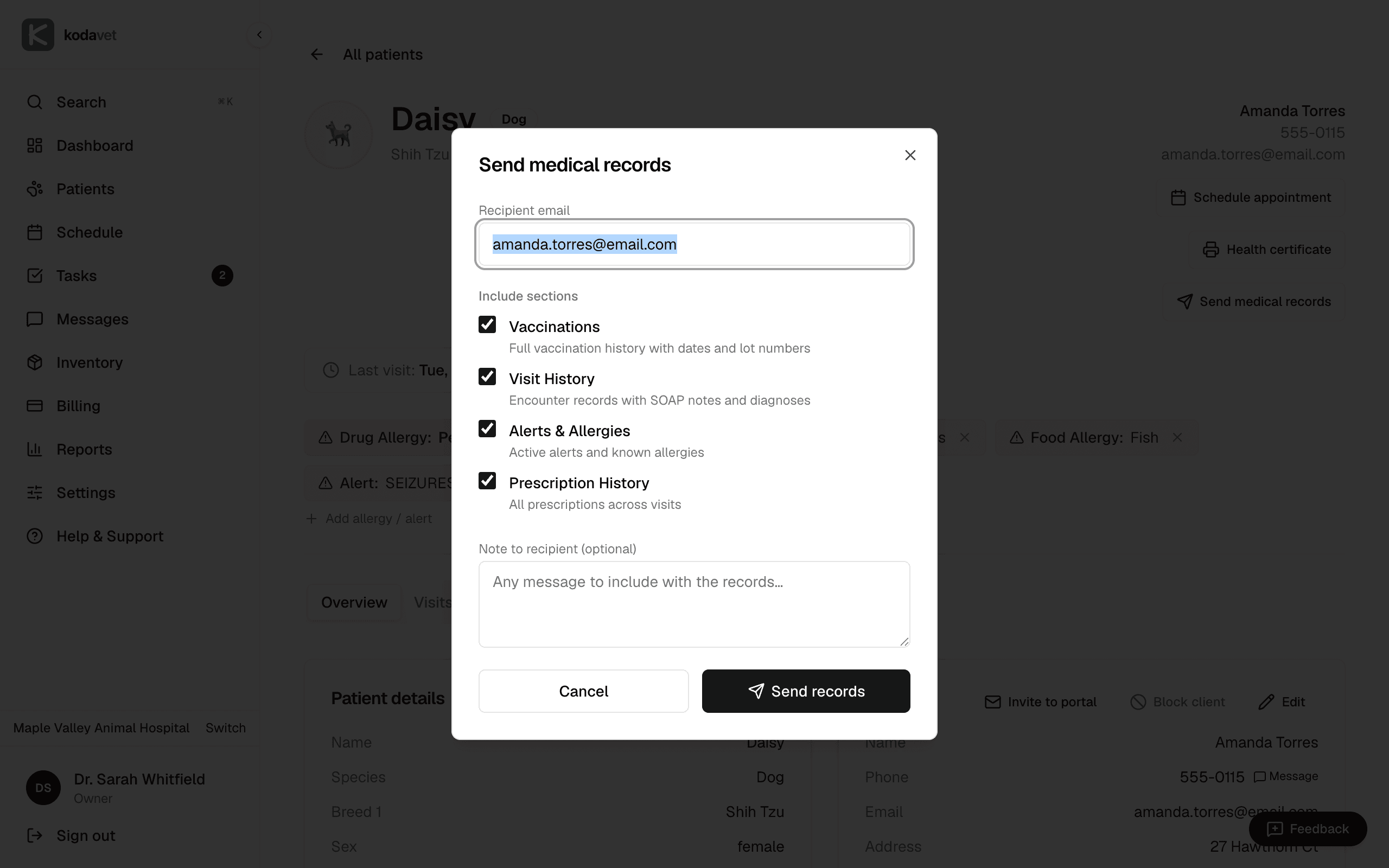
The better version is to select which sections to include — vaccinations, visit history, alerts and allergies, prescription history — type the recipient, add a note, and send a formatted record straight from the patient's chart. It takes seconds, it's consistent every time, and it closes the loop on the ownership change without anyone copying and pasting.
The system side of this
None of this is exotic. Pets get co-owned, rehomed, adopted, and inherited in every general practice, every week. The reason it feels like friction is that a lot of veterinary software was built around a rigid one-pet-one-owner model and never revisited it. The fix isn't a workaround — it's software that treats ownership as something that can change without the medical record paying the price.
KodaVet handles all three: add a co-owner to any patient, relocate a pet to a new owner with its full history intact, and email a formatted medical record in a few clicks. See how patient records work, or try it free for 14 days with your own clinic data — no credit card required.